Can Psychedelics Help with Trauma? Navigating Legal Support and Inner Exploration

Dr. Ansgar Rougemont-Bücking is a board-certified psychiatrist, psychotherapist, researcher, and author based in Switzerland.
Specializing in psychotraumatology and addictive disorders, his clinical work focuses on addressing major life-acquired psychiatric challenges. He is recognized as a pioneer in Switzerland in the field of psychedelic-assisted psychotherapy.
As an academic and researcher, his work integrates neuroscience, psychopathology, and depth psychology to study emotional coping and trauma resolution. He is also the author of Vampirocene, where he analyzes structural traumatic dissociation and its societal impacts.
In addition to clinical practice, he provides supervision for therapists and leads mind-body-nature therapeutic experiences. Overall, he brings a unique transdisciplinary perspective combining neuroscience, integrative therapy, and extensive clinical expertise.
Dr Rougement-Bücking, could you introduce yourself?
“My name is Ansgar Rougemont-Bücking. I’m a psychiatrist and psychotherapist living and working in Switzerland. I am originally from Germany. I immigrated to Switzerland in 1999. About 25 years ago, I was working with severe drug addicts in Lausanne, who were doing heroin or cocaine, and I realized that these people were traumatized. That’s why I got interested in psychotraumatology. I was lucky to be able to make a scientific sabbatical year in Boston. I did research at Harvard University about PTSD and I was doing training in Bethel Fonda’s trauma center clinic. I then learned EMDR, eye movement desensitization reprocessing.
A couple of years later, I was lucky to discover the psychedelic approaches in psychotherapy. I was one of the rare doctors in Switzerland who were practicing this for a couple of years.
EMDR is also a great tool to explore and heal trauma. I would often start therapy with EMDR because it’s still quite controllable. There is this idea that the person can at any moment say stop. But with psychedelic substances, once you’ve taken them, there’s no getting out of it for the next couple of hours or for the whole day.”
What is EMDR?
Eye Movement Desensitization and Reprocessing (EMDR) is a structured psychotherapy designed to help people heal from trauma and distressing life experiences. Unlike traditional talk therapy, EMDR focuses directly on changing how traumatic memories are stored in the brain. During a session, a trained therapist guides the client to focus on a painful memory while simultaneously experiencing side-to-side sensory input, known as bilateral stimulation. This stimulation typically involves tracking the therapist’s finger movements with the eyes, alternating audio tones, or gentle tactile taps.
The back-and-forth movement engages both sides of the brain, dynamic similar to what occurs during REM sleep. This dual-attention focus allows the brain to reprocess stored emotional distress without forcing the client to talk about the trauma in detail. Over time, the intense emotional charge and physical distress associated with the memory fade. EMDR is widely recognized by organizations like the WHO as an effective treatment for post-traumatic stress disorder (PTSD), anxiety, and depression. Ultimately, it helps individuals integrate difficult memories into their past so those experiences no longer disrupt their present life.
What kind of therapy or work do you do in Switzerland?
“In Switzerland, I have the privilege of being able to support people in this kind of exploration of different substances we have to work with. It’s important to get the government authorization. We need to get the approval of the government for every patient and all the substances. We can then order the substances in a pharmacy.
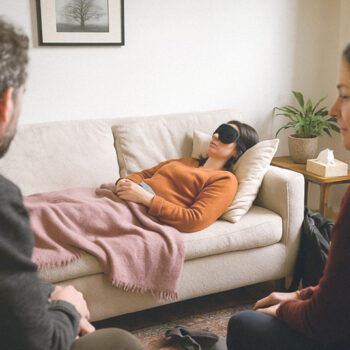
It’s always interesting in the follow-up sessions, when people are regressing in age during the sessions and then all of a sudden there are coming up with something quite ancient. Often, they are overwhelmed with something very emotional; they are living with the panic or the stress of that situation in real time, again. We have to support them. I have to support them as much as possible.”
How do you combine psychedelic substances and therapy?
“About psychedelic substances, I always go gradually. I normally only accept this kind of therapy for patients I know very well, which I have been following for quite a time already. And normally, I also send people to do breath work somewhere before that. It’s the first step.
Then I always do several sessions with ketamine, something that improves a lot this kind of experience. It’s not too long. It’s not too heavy. And then if the ketamine process goes well, I go and propose MDMA. It’s the first special substance in Switzerland. And then, later maybe, MDMA, LSD or psilocybin.
Starting with ketamine has a lot of advantages. It’s quite short in duration. It’s not expensive as a substance, and you can use it in addition to all kinds of other medications. For instance, if we use MDMA for our patients, they have to stop antidepressants for a while. This can be difficult for some patients to do. With ketamine, you can just add it and can discover and explore an altered state of consciousness state with your patients. It is intense, but not too long, and not too challenging for them.”
What is MDMA?
MDMA (3,4 methylenedioxymethamphetamine), commonly known as Ecstasy or Molly, is a synthetic psychoactive drug that acts as both a stimulant and an empathogen. It primary functions by triggering a massive release of neurotransmitters in the brain (specifically serotonin, dopamine, and norepinephrine), which leads to heightened energy, emotional warmth, increased empathy, and altered sensory perception. While historically used recreationally, controlled clinical research evaluates its potential as an adjunct to psychedelic-assisted psychotherapy for severe trauma and PTSD due to its ability to temporarily reduce fear responses while processing difficult emotions.
What is ketamine?
Ketamine is a synthetic medication primarily classified as a dissociative anesthetic, meaning it induces sedation, pain relief, and a feeling of detachment from one’s environment or body. It works mainly as an NMDA receptor antagonist in the brain (NMDA means N-methyl-D-aspartate), altering glutamate signaling to block pain perception and disrupt standard neural pathways. Widely used in surgical and emergency medicine for human and veterinary anesthesia, ketamine has also gained significant attention in psychiatry. Sub-anesthetic doses are utilized off label and in specialized clinics to provide rapid-acting relief for treatment-resistant depression, severe anxiety, and PTSD.
What about psilocybin or LSD?
“Depending on the situation, I would rather opt for psilocybin when there are a lot of somatic difficulties and suffering in the body. Psilocybin is quite intense for bodily exploration. LSD is more about intellectual rigidity: people are thinking in a certain way and are blocked in this. LSD helps them unlock their mind. Both are fine, but another disadvantage of LSD is that it’s quite long. We are talking about very long sessions of 10 hours or more.”
What is psilocybin?
Psilocybin is a naturally occurring psychedelic compound produced by over 200 species of fungi, commonly known as magic mushrooms. Once ingested, the body rapidly converts psilocybin into psilocin, which acts primarily as an agonist at serotonin receptors in the brain. This interaction alters perception, mood, and cognitive processing – often inducing visual shifts, emotional breakthroughs, and a temporarily dissolved sense of ego. Long used in indigenous spiritual and healing traditions, psilocybin is currently a major focus of clinical research, where psilocybin-assisted psychotherapy is evaluated for its capacity to promote neuroplasticity and provide lasting relief for treatment-resistant depression, end-of-life distress, and substance use disorders.

What is LSD?
LSD (lysergic acid diethylamide), commonly known as acid, is a potent synthetic psychedelic compound derived from ergot, a fungus that grows on grains like rye. First synthesized by Albert Hofmann in 1938, LSD functions primarily as an agonist at serotonin receptors in the central nervous system. Even in microgram doses, it produces profound alterations in consciousness, visual perception, time processing, and emotional awareness by temporarily reorganizing functional connectivity across brain networks. Beyond its cultural history and recreational use, contemporary clinical trials are investigating LSD-assisted psychotherapy for its potential to foster long-term psychological flexibility and alleviate anxiety, depression, and cluster headaches.
Can psychedelics help trauma healing?
“Sometime, with psychedelics, there is the revelation of traumatic amnesia, about abuse, for example. It’s very difficult to predict. It can sometimes happen in a first session; people realize something they had kind of forgotten. But it’s not so typical.
I always refer to the idea of the inner healer, which is this authority somewhere in the mind that controls access to difficult content. It’s always the question if the person’s organism is able to hold that information in order to survive. Sometimes, we have to protect ourselves and we have to respect this as a therapist. We also have to be very cautious about interpretations. This belongs to the patients. It’s not mine. My agenda is not to reach something in that session. It’s the inner healer of the patient who’s doing the work, addressing a little bit maybe. And then we have to integrate that into daily life. Sometimes it takes months or years to fully integrate and understand an experience. And that’s something that is really important to say to people who envisage a psychedelic experience.
It’s an intense experience. It’s something that can change your life and at the same time, sometimes, it’s difficult to make sense of it. Sometimes the inner healer is not ready for this information.
The definition of trauma I apply is the one from Pierre Janet, the French psychologist and traumatologist from the 19th-20th century. He defines trauma as a lack of integration. It’s an overwhelming emotional shock that exceeds a person’s mental capacity to integrate it, leading to dissociation, the formation of unconscious ‘fixed ideas’, and recurring fragments of the event. It keeps living as a ‘haunted identity’’.
Do you recommend morphine in case of dissociation?
“For this type of dissociation, we can also use morphine when the pain is too strong, when something is too painful, and when the organism is overcharged. If we can manage to lower that pain by applying opiates for people being traumatized, then the system is less overcharged. There are studies that show that if you give people in emergency room opiates, they have a lower risk of developing PTSD later because the pain system is better regulated by these substances. Of course, it’s true you can become addicted to these kinds of substances, but you have to measure the pros and cons of all the interventions. And in my opinion, if you let a person without protection when they are overwhelmed, they risk developing a long-term sequel to that situation of overcharge. Then there might be a good reason to give, for a couple of days or a couple of hours, such a substance, in order to soothe the system down and allow that person to heal better. Heal in a better way than without that kind of substance.”
What is morphine?
Morphine is a powerful non-synthetic opioid analgesic naturally derived from the opium poppy plant (Papaver somniferum). It acts primarily as a potent agonist at mu-opioid receptors in the central nervous system, effectively blocking pain signals from reaching the brain while altering the emotional response to pain. Regarded as the gold standard for severe acute and chronic pain management, morphine is extensively used in surgical care, trauma medicine, and palliative end-of-life care. However, because it also triggers a release of dopamine in reward pathways, its clinical administration requires careful monitoring due to risks of respiratory depression, physical dependence, and addiction.
Do you recommend other substances that may heal trauma?
“There is also buprenorphine. The big advantage of buprenorphine is that it yields a threshold of action in the brain that protects the organism not to go into overdose.”
What is bruprenorphine?
Buprenorphine is a synthetic opioid partial agonist at the mu-opioid receptor and an antagonist at the kappa-opioid receptor, designed to provide ceiling-limited receptor activation that minimizes the risk of respiratory depression. Clinically, it is used as a standard-of-care medication for Opioid Use Disorder (OUD) to suppress cravings and withdrawal, as well as for chronic pain management.
In the context of psychotherapy, buprenorphine serves as an essential pharmacotherapeutic anchor within Medication-Assisted Treatment (MAT). Combining buprenorphine with behavioral therapies (such as Cognitive Behavioral Therapy or trauma-informed counseling) helps patients maintain neurological stability while addressing the psychological drivers of addiction and comorbid emotional distress. Additionally, due to its kappa-opioid receptor blockade, which reduces dysphoria, very low doses of buprenorphine are being explored in clinical research for treatment-resistant depression and severe suicidal ideation.
Addiction risks and psychedelic substances
Substance-induced addiction potential varies significantly across pharmacological classes: morphine poses a high risk of dependence and misuse; ketamine and MDMA demonstrate moderate-to-low addiction potential; and classical psychedelics such as LSD and psilocybin exhibit a remarkably low risk of physical dependence or addictive behavior.
- High Dependence Risk: Morphine (potent mu-opioid receptor agonist associated with rapid tolerance and physical dependence).
- Moderate-to-Low Risk: MDMA, ketamine and buprenorphine (demonstrate abuse potential, but lower physical dependence profiles under controlled clinical conditions).
- Very Low Risk: LSD and psilocybin (serotonergic psychedelics characterized by a lack of compulsive self-administration and absence of physical dependence).
Why do you think people with trauma take drugs?
“Usually, people take drugs because they can’t deal with the sequel of a traumatic state. That’s one of the most important reasons why people take substances. People often discover psychedelic substances in the normal life context and then they get addicted because there are no better solutions for them. At least, that’s what they think at this stage.”
What is your opinion about opiates and depression?
“There are some rare few studies that suggest that it might be useful to apply opiates to people who are living in a severe suicidal crisis. They want to kill themselves and that might be a very efficient treatment to soothe the pain. Opiates could save many lives in these situations, in my opinion. Also, depression is a pain state, basically. Why do we not consider soothing that pain with opiates? Because we are afraid of creating an addiction. I understand that. But what is the problem with being addicted to opiates when it’s well managed? You know, I always bring in the comparison with insulin. There is a risk of dying from the deregulation of your metabolism and you can die from that if you’re diabetic, for instance, because there’s not enough or no insulin in your system. The analogy is that, maybe, for people with chronic depression who are traumatized, there’s a mismatch in the presence of opiates in the brain. They’re suicidal because there’s so much pain. Maybe we could sooth that pain and give these people a decent quality of life if we apply these substances. But there’s a huge taboo because we don’t want to make people addicted. In my opinion, it’s worth considering that maybe a person can choose. I take opiate medication every day for the rest of my life, but I have a decent quality of life and I’m not being in pain all the time. Maybe fewer people will commit suicide; there will be less traumatized people in the families where family members commit suicide if you do this kind of pragmatic approach for me.
It’s accepted socially that morphine or opiates can be taken for physical pain. But when we’re talking about psychological pain, then people think, ‘No, that’s not allowed.’
We allow antidepressants for people suffering from depression. Depression is a psychological pain that is accepted. We give antidepressants to people to be a bit numbed from the pain. Opiates are not numbing; they are just targeting the pain more specifically. That’s an advantage of opiates compared to antidepressants. But antidepressants are much more accepted socially.
With antidepressants, the person is able to function as normally as possible, because he or she is less feeling the pain or the difficulty in daily life. That is something that was kind of constructed in the narrative of what pharmacotherapy is. We allow people to function and to go back to work and back into family roles. This is considered to be a healing or good treatment. But we are not really aware of the phenomenology of the person who still may be able to function, but still is in a loss of sense. And the pain might still be somewhere present.
In my practice, I sometimes have people who have both depression and a pain syndrome, or psychosomatic pain. Sometimes, these people are encouraged to take opiate medication. They then realize that both the psychological pain and the physical pain are south by opiates. I observe that, in some of my patients, with the substances, they get better, not only on the pain level, but also on the mood level. I encourage people to take this substance without feeling any guilt and shame. There is stigmatism that these substances are bad. If you take them, you’re considered a drug addict, you are considered a weak person… by society.”
Sources
- Bhivandkar S, Sarfraz Z, Jain L, Bachu A, Malo PK, Hsu M, Ayub S, Poudel L, Kumar H, Loh H, Tazin F, Ahmed S, Suzuki J. Therapeutic Potential of Buprenorphine in Depression: A Meta-Analysis of Current Evidence. J Clin Med Res. 2024 Mar;16(2-3):46-55. doi: 10.14740/jocmr5050. Epub 2024 Mar 16. PMID: 38550549; PMCID: PMC10970042.
- Clinical Trials – Buprenorphine
- Behavioral therapy as an adjunct to buprenorphine treatment for opioid use disorder: a secondary analysis of 4 randomized clinical trials, HRB National Drugs Library
- UAMS, Psychiatric Research Institute, What is Buprenorphine?
- UK Addiction Treatment Centres
- How can psychedelics support some people within a legal framework?, enfin
The perspectives, insights, and clinical observations shared by Dr. Ansgar Rougemont-Bücking represent his personal and professional views based on his research and experience. This article is intended strictly for educational and informational purposes and does not encourage, advocate, or promote the non-medical or illegal use of psychedelics or any other controlled substances. Readers are strongly advised to adhere strictly to the laws, legal frameworks, and medical regulations of their respective countries regarding controlled substances and to consult qualified healthcare professionals before considering any therapeutic intervention.
Written by Arnaud Beauregard,
Founder of Tangerine Retreat in 2022, I have followed several paths: initially trained as an engineer and then as an entrepreneur, I later pursued training in hypnotherapy to better understand the inner workings of the human mind. I discovered psychedelics at the age of 55. My encounter with altered states of consciousness proved to be a profound revelation which, over time, became a genuine passion.
Last updated on 29 August 2026