


Psychedelic-assisted Therapy
What Is Psychedelic Therapy?
Imagine a form of care that does not merely aim to relieve symptoms, but to restore harmony within the mind. A process that seeks to illuminate certain areas of memory in order to correct failing mechanisms. This is the ambition of psychedelic therapies, an approach that combines psychoactive substances such as psilocybin with deep psychological support.
A Method to Change One’s Perspective on the Self
It is an innovative treatment based on a lucid, often intense exploration of the psyche. The goal is to achieve lasting realignment through the hallucinogenic effects of magic mushrooms.
For several hours, the patient experiences an expansion of consciousness filled with flashes of insight, profound realisations and emotional releases that sometimes open new access to the unconscious.
This limited period acts as a catalyst for change. It can lead to transformation as efficiently as dozens of psychotherapy sessions.
Scientific studies agree that the benefits for mental health are significant.
An Intense but Structured Experience
When people imagine “psychedelic trips”, they often picture hippies, festive or New Age atmospheres halfway between spirituality and play. Psychedelic-assisted therapy, however, belongs to a completely different realm.
It is not a careless leap into the unknown. It follows a precise and controlled protocol. A medical or therapeutic framework generally includes:
- A preparation phase;
- One or several sessions under the substance;
- A post-session integration process.
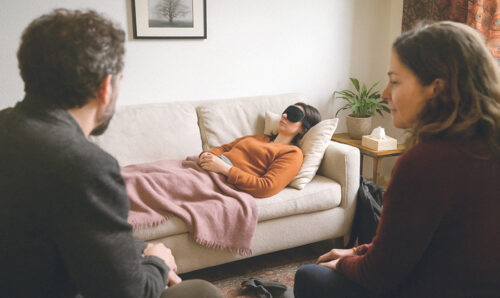
All of this takes place under the supervision of trained professionals in a safe environment. The psychedelic session is often conducted in the presence of two therapists.
Far more comprehensive than a simple medication, it is a deep process that helps normalise brain function. A long-term medical approach whose benefits appear gradually.
The Benefits of Psychedelic-Assisted Therapy
Scientifically Documented Benefits
Psilocybin has been tested in patients suffering from severe depression, post-traumatic stress disorder and chronic anxiety. According to clinical studies, it can work where other treatments fail. Yet it does not replace standard medication, which remains effective in most typical cases.
Results published in The New England Journal of Medicine and Nature Medicine show marked improvements after only one or two sessions.
| Étude | Single psilocybin dose / treatment-resistant patients (NEJM, 2022) | Psilocybin vs Escitalopram / severe depression (Nature, 2021) |
|---|---|---|
| Protocol | Groups : 25 mg / 10 mg / 1 mg (control). – One supervised session. – Psychological support. | Groups: – Two 25 mg doses (three weeks apart). – Six weeks of escitalopram (10–20 mg/day). |
| Results | Average decrease in depressive symptom score (MADRS) after 3 weeks: – 25 mg : -12,0 pts – 10 mg : -7,9 pts – 1 mg : -5,4 pts | Average decrease in depressive symptom score (QIDS-SR-16): – Psilocybin: –8.0 pts; – Escitalopram: –6.0 pts. |
| Improvement | Participants with more than 50% decrease in MADRS: – 37% (25 mg). – 18% (1 mg). | Participants with more than 50% decrease in QIDS-SR-16: – 70% (psilocybin). – 48% (escitalopram). |
| Remission | Non-depressive state at 3 weeks: – 29% (25 mg). – 8% (1 mg). | Non-depressive state at 6 weeks: – 57% (psilocybin). – 28% (escitalopram). |
An Emotional Reset and a Window of Opportunity
How can these effects be explained? Researchers sometimes speak of a mental “reset”.
Under psilocybin, brain connections are temporarily reorganised. Neural networks become more flexible and less rigid. Different brain regions start to communicate together. This helps patients step outside repetitive thought patterns or revisit traumatic memories with new understanding, sometimes even with compassion.
It opens a therapeutic window for deep psychological work, which is then reinforced by several weeks of integration.
A Change in Perspective
One of the major advantages of these therapies lies in their transformative potential after just a few sessions. Conventional antidepressants require continuous intake and primarily target symptoms.
Psilocybin, on the other hand, offers an experience that can transform the way patients relate to their suffering. The pain does not vanish overnight. It is the perception of it that changes.
During the psychedelic journey, something happens within the realm of traumatic memory. Each participant describes it in their own way:
- Profound understanding of why events occurred (insight).
- Ability to give meaning to painful experiences.
- Detachment and distance from trauma.
- Gratitude for other life events that provide strength.
A New Relationship with Life
Beyond the clinical aspect, many participants describe an existential effect. A sense of unity, ego dissolution and connection to all living things. Words that might sound mystical, yet in a therapeutic context they reflect a form of reconciliation with oneself, with others or with the world.
It often leads to a renewed capacity to face life.

Comprehensive 18-month guidance
Accessible and legal psychedelic support
Preparation and integration
3 psilocybin experiences in the Netherlands
Ongoing support before, during and after the sessions with a English-speaking practitioner
How Does a Psychedelic Therapy Session Work?
The Central Role of the Framework: Without Guidance, No Healing
When taking part in a magic mushroom therapy, benefits are not automatic. The molecule itself does not heal on its own. What truly heals is the process as a whole and the quality of support and integration.
Without structure, a psychedelic experience can become confusing or destabilising. The presence of therapists, the trustful relationship, emotional preparation and the post-session debriefing are the real foundations of healing. The framework is what enables therapeutic effects and prevents bad trips.
Preparation
Preparation involves conversations about oneself, expectations and the therapeutic method. It builds a bond between the patient and practitioners.
This trust then allows the patient to feel safe during the psilocybin experience. To let go and welcome whatever arises: painful emotions, memories, insights or feelings of love and belonging.
Le trip
The psychedelic journey is a moment of deep calm. Lying down in a quiet room and immersed in music, the patient travels through layers of the subconscious for several hours. If they need to speak, the guides are present. Most of the time, it is an inner voyage.
Integration
Integration is perhaps the most crucial step in psychedelic therapy. Over several months, follow-up sessions with the practitioner take place.
Somewhere between coaching and therapy, the patient analyses the experience, observes changes and identifies possible blocks. Together they agree on exercises or new habits to make the most of the insights gained.
After a few months, a second psilocybin session and another integration cycle may be organised to reinforce earlier progress. This is particularly beneficial for treating depression or alcoholism.

Psychedelic Therapies: Where, for Whom, and at What Cost?
Global Enthusiasm but Limited Access
Psychedelic-assisted therapy protocols are increasingly common in scientific journals, pilot hospitals and high-end clinics.
Yet access remains extremely restricted. Few countries authorise these treatments outside clinical trials, and even where they are legal, joining a programme is often a long and difficult process.
- Australia became the first country to legalise supervised psilocybin use for treatment-resistant depression in 2023. Only accredited psychiatrists can prescribe it, within licensed clinics. In 2025, New Zealand followed suit by accrediting a single physician.
- Oregon, in the United States, has taken a different path, allowing supervised psilocybin use even outside psychiatric diagnoses, provided that facilitators and centres are certified.
- In Switzerland, medical use has been authorised on a case-by-case basis since 2014 under psychiatric supervision, and only for residents.
- Some European countries, such as the Czech Republic and Germany, have also allowed a handful of practitioners to offer mushroom-based therapy, but the conditions are strict and places are limited.
Access nearly always requires a rigorous screening process. Pathologies must be confirmed, medical history carefully reviewed, and any psychiatric contraindication such as bipolar disorder or psychosis leads to exclusion.
Many people interested in psychedelic therapy therefore cannot access it, either medically or legally.
What About Psychedelic Therapy in UK?
There is currently no legal option available. British citizens often travel to the Netherlands to join a psilocybin retreat.
The Case of the Netherlands
In the Netherlands, magic truffles are legally sold, which has allowed the creation of guided retreats, some of which are well organised. Yet only a few provide comprehensive psychological support.
These retreats often attract people seeking personal growth, but they are not always designed for long-term therapeutic follow-up.
The Cost Barrier
Another major obstacle is the cost. A full therapy programme including preparation, supervised session and integration can range from €6,000 to €12,000 depending on the country, centre and duration. In Australia, prices vary between 6,000 and 8,000 Australian dollars. In the United States, some clinics charge around 12,000 dollars for a complete protocol.
To date, no public health system reimburses these treatments, and very few insurance plans cover them. Accessibility remains largely limited to affluent groups or participants in clinical trials, which are free but highly selective.
Clear Indications but Broader Potential
Current studies focus on specific conditions such as treatment-resistant depression, post-traumatic stress disorder and alcohol addiction. Naturally, psilocybin-assisted therapies are mainly aimed at these pathologies.
However, researchers see potential for a much wider range of applications: anxiety disorders, complicated grief, obsessive-compulsive disorder, anorexia and even some forms of chronic pain. The challenge lies in expanding the indications without losing scientific rigour or falling into naïve enthusiasm.
The “Forgotten Patients” of Psychedelic Therapy
At present, psychedelic-assisted therapies include only certain conditions. Many others are excluded from protocols. People living with chronic pain, eating disorders or prolonged grief find themselves left out.
Yet some preliminary studies suggest promising effects. The issue lies in the lack of data, perceived risks and limited funding.
This is the paradox: while results are encouraging, progress towards broader availability remains slow, expensive and unequal.
Did You Know?
The word psychedelic comes from the Greek psyche (soul) and delóô (to manifest, to reveal). It literally means “that which reveals the soul.” The term was coined in the 1950s by psychiatrist Humphry Osmond to describe a new class of substances that, in his view, gave access to profound truths about the self.
FAQ
It is, above all, a matter of guidance and support. Therapists build a framework of trust with the patient. Together, they explore past trauma or existential pain. The intake of hallucinogenic mushrooms or truffles then acts on brain chemistry, reshaping the patient’s relationship to suffering.
It varies widely. In terms of fresh magic truffles, the dose usually ranges between 15 and 40 grams. Each institute has its own dosage standards.
There are certain contraindications: recent use of antidepressants, a history of psychosis, or cardiac rhythm disorders. Therapy centres use medical questionnaires to ensure that patients do not take unnecessary risks.
There are only a few, and access conditions are strict. Dedicated and accredited centres exist in Switzerland, Australia, Canada and the United States. A new service has recently opened in Germany, within Mannheim Hospital.
No. Psychedelic therapy is not available in UK, where psilocybin is still classified as a psychoactive drug. No official projects have been launched to date.
The psychedelic experience lasts around five to six hours. However, its psychological effects can extend over several months, sometimes years. The goal of psychedelic therapy is to harness these effects to make introspection more effective through long-term support.
In mental health treatment, two psychedelics currently have legal therapeutic use: psilocybin and MDMA (in Australia). Psilocybin has shown effectiveness in treating depression, anxiety, addictions and trauma. MDMA may provide additional benefits for complex post-traumatic stress disorder (PTSD).
Image from senivpetro on Freepik
Written by Arnaud Beauregard,
Founder of Tangerine Retreat in 2022, I have followed several paths: initially trained as an engineer and then as an entrepreneur, I later pursued training in hypnotherapy to better understand the inner workings of the human mind. I discovered psychedelics at the age of 55. My encounter with altered states of consciousness proved to be a profound revelation which, over time, became a genuine passion.
Last updated on 4 February 2026